Support For Working Professionals

Whether you're starting your first job, returning to work, or looking for support to manage workplace challenges, Access to Work funding may be able to pay for specialist coaching .
Funded By Access to Work (ATW) -
Funded By Access to Work (ATW) -
You may never have heard of Access to Work before—and you're certainly not alone.
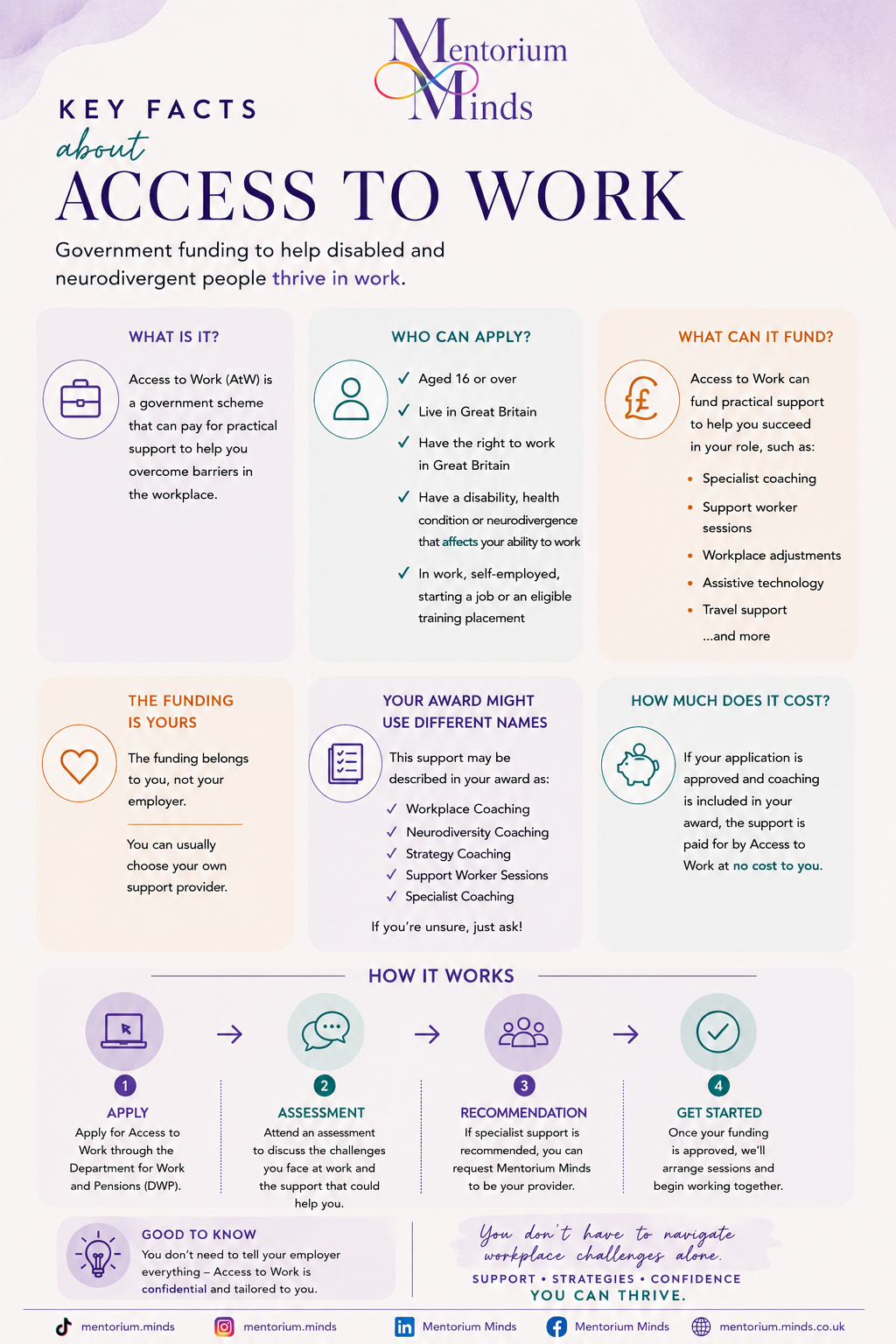
Access to Work (AtW) is a government-funded grant designed to help disabled and neurodivergent people overcome barriers in the workplace.
The funding is there to help you work more effectively by providing practical support that's tailored to your individual needs. Depending on your circumstances, this could include specialist coaching, workplace equipment, travel support and much more.
The aim is simple: to remove barriers that make work more difficult, so you can focus on doing your job with confidence.
What is Access to Work (ATW) Support?
Frequently Asked Questions (FAQs)
-
ATW can fund practical support to help you overcome barriers you experience at work. Depending on your individual needs, this may include:
Specialist workplace coaching
Assistive technology and specialist equipment
Support workers
Communication support
Travel to and within work
Changes to equipment or adaptations in the workplace
The support recommended will depend on your individual circumstances and the barriers you experience at work.
-
You may be eligible for ATW if you:
Are aged 16 or over
Have a disability, health condition or mental health condition that affects your ability to do your job
Are in paid employment, self-employed, about to start a job or returning to work
Live and work in England, Scotland or Wales
Eligibility is based on your individual circumstances and how your condition affects you at work.
-
Apply online at https://www.gov.uk/access-to-work or call 0800 121 7479 through the Access to Work scheme.
An adviser will contact you to discuss your role and the support you may benefit from.
If appropriate, you'll receive an Access to Work award outlining the support that's been approved.
If specialist workplace coaching is included, you can inform your adviser that you'd like Mentorium Minds to provide your support.
-
ATW is a government-funded grant, so you will not usually be expected to pay for approved support yourself.
The amount of funding awarded depends on your individual needs and the support recommended.
In some circumstances, your employer may be required to contribute towards the cost of certain types of support.
If specialist workplace coaching is included in your ATW award, the funding can be used towards the cost of your approved sessions.
-
Not necessarily. ATW focuses on how a disability or health condition affects you at work rather than diagnosis alone.
You may, however, be asked to provide information about your condition and how it affects your ability to work.
-
Mentorium Minds offers remote support, allowing sessions to fit around your working day and removing the need to travel.
Face-to-face support may also be available in South Wales subject to availability.
-
ATW is one of the UK's lesser-known government support schemes, so many people don't hear about it until they start a new job, speak to their employer or search for workplace support.
If you're only discovering it now, you're certainly not alone.
Common Workplace Challenges
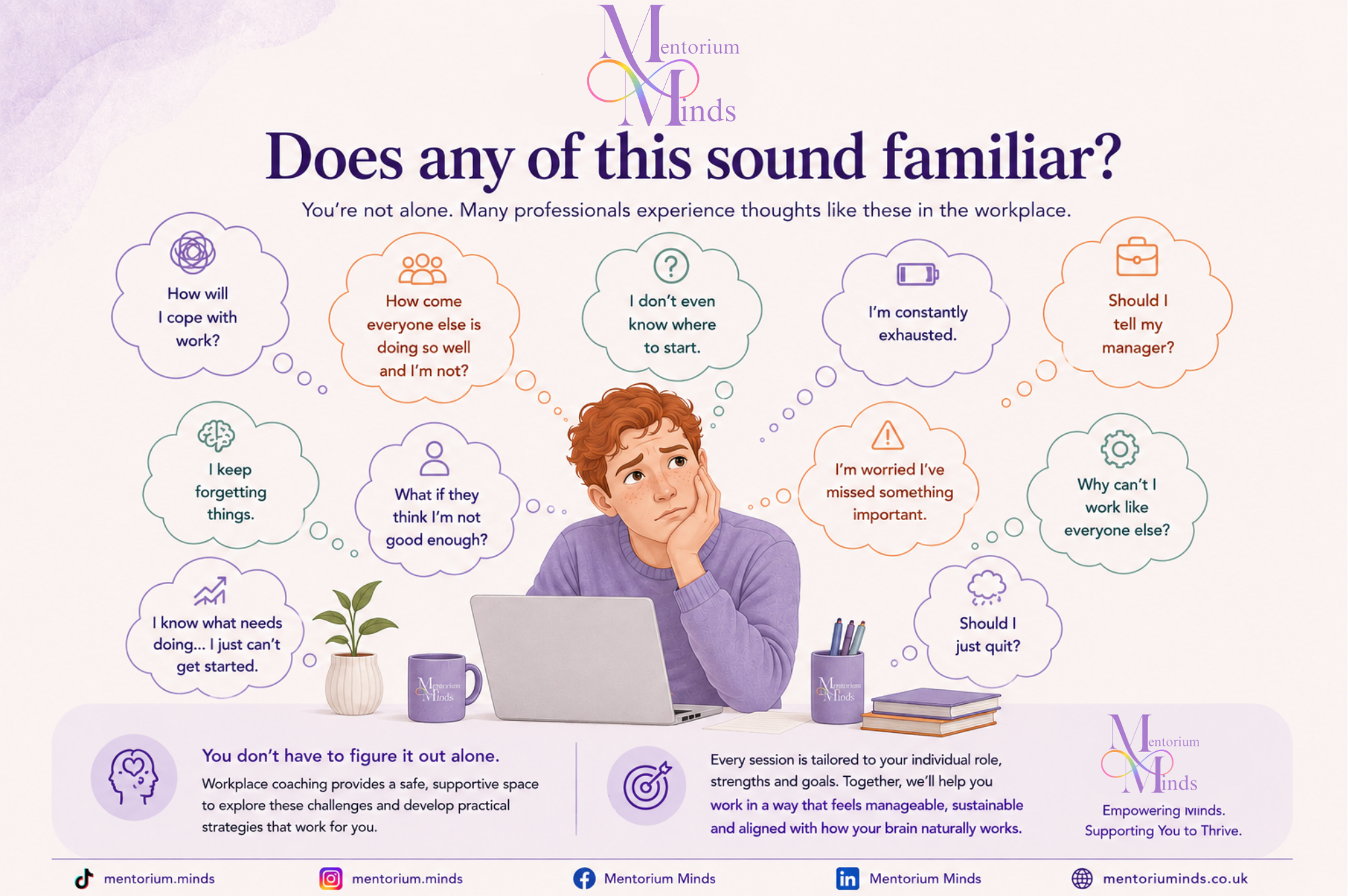
If any this resonates with you, you're not alone.
Whether you've just started your very first job, landed the graduate role you've worked so hard for, built a career around a lifelong passion, or you're simply working to pay the bills, one thing remains the same: everyone deserves to feel supported at work.
Work involves far more than simply doing the job itself. Alongside your day-to-day responsibilities, you may be juggling competing priorities, switching between tasks, navigating workplace relationships, interpreting unspoken expectations, managing deadlines, adapting to change or simply trying to stay on top of an ever-growing workload. Over time, these pressures can leave anyone feeling overwhelmed, exhausted and questioning their own abilities.
For neurodivergent people, includingmany autistic and ADHD professionals, these challenges can be even more profound. Many workplaces, systems and expectations have traditionally been built around neurotypical ways of thinking, communicating and working. This can mean that tasks such as managing executive functioning, coping with sensory demands, interpreting social expectations or maintaining focus throughout the day require significantly more mental effort than others may realise.
It's easy to begin questioning your abilities, when in reality the challenge often lies in trying to thrive within environments that don't naturally accommodate the way your brain works. You might find yourself masking, pushing through exhaustion or working twice as hard just to achieve the same outcome, increasing the risk of stress, burnout and reduced confidence over time.
Workplace coaching isn't about changing who you are. It's about understanding how you think and work, recognising your strengths, identifying the barriers that are getting in the way, and developing practical strategies that allow you to work more confidently, sustainably and authentically. Because you shouldn't have to spend all of your energy trying to fit into a workplace that doesn't always fit you.
Every person's experience is different, which is why every mentoring/coaching programme is tailored to your individual role, strengths and goals. Below are just some of the areas we can explore together.
How Can Mentorium Minds Help?
Executive Function & Organisation
Practical strategies for planning, prioritising and managing deadlines — so a busy workload feels structured rather than overwhelming.
Managing Change & Transitions
Whether you're changing roles, adapting to new responsibilities or navigating organisational change, build confidence to adapt at a pace that works for you.
Wellbeing & Work-Life Balance
Reduce overwhelm, manage stress and build healthy boundaries and routines that protect your energy, both at work and beyond.
Workplace Communication
Build confidence navigating meetings, relationships and feedback — and communicate your strengths and support needs effectively to managers and colleagues.
Career Development
Support doesn't stop once you've settled in. Coaching can help you navigate changing responsibilities, promotions, workplace transitions and the challenges that arise throughout your career.
Reasonable Adjustments
Identify workplace adjustments that could genuinely improve the way you work, and receive support to understand, request and make the most of them.
Workplace coaching isn't about becoming “more neurotypical”.
It's about understanding how your brain works, recognising your strengths and developing practical strategies that allow you to succeed without compromising your wellbeing, confidence or authenticity.
Your Access to Work Cheat Sheet
A handy reference guide you can come back to whenever you need it.
Save or screenshot for easy access.