Specialist Mentoring (ASC)
Personalised one-to-one support for neurodivergent students to help you thrive at university.
Availability for Academic Year 2026-2027
Accepting new DSA-funded Specialist Mentoring (ASC) students for online support UK-wide (remote) and across Cardiff/South Wales (in person). View NMH provider rates.
Last updated: September 2026

Funded by Disabled Students' Allowance (DSA)
〰️
Funded by Disabled Students' Allowance (DSA) 〰️
If you're a neurodivergent student in higher education and your DSA Needs Assessment has recommended Specialist Mentor (ASC) support, you're in the right place.
Specialist Mentoring is funded through Disabled Students' Allowance (DSA), providing eligible students with personalised one-to-one support throughout their studies.
Every mentoring relationship is different.
Sessions are tailored to your individual needs and may focus on areas such as organisation, executive functioning, managing overwhelm, communication, confidence and developing strategies that help you thrive at university.
If any of this resonates with you, you're not alone.
Whether you're about to start university, finding your feet in first year, trying to keep up with increasing academic demands or approaching graduation, university can feel overwhelming at times.
Alongside lectures and assignments, you may be managing independent living, making new friends, navigating unfamiliar environments, balancing deadlines and trying to keep on top of everyday life—all at the same time.
For many neurodivergent students, including those with autism and ADHD, these challenges can be even more profound. Universities are often designed around neurotypical ways of learning, communicating and organising, meaning everyday tasks can require significantly more time, energy and mental effort than others realise.
You might begin to wonder why everyone else seems to be coping so much better, question whether you belong at university, or feel guilty for needing support. In reality, many students experience exactly these thoughts, and asking for support is a strength—not a weakness.
Specialist Mentoring isn't about changing who you are. It's about understanding how your brain works, recognising your strengths and developing practical strategies that help you succeed academically while protecting your wellbeing, confidence and independence.
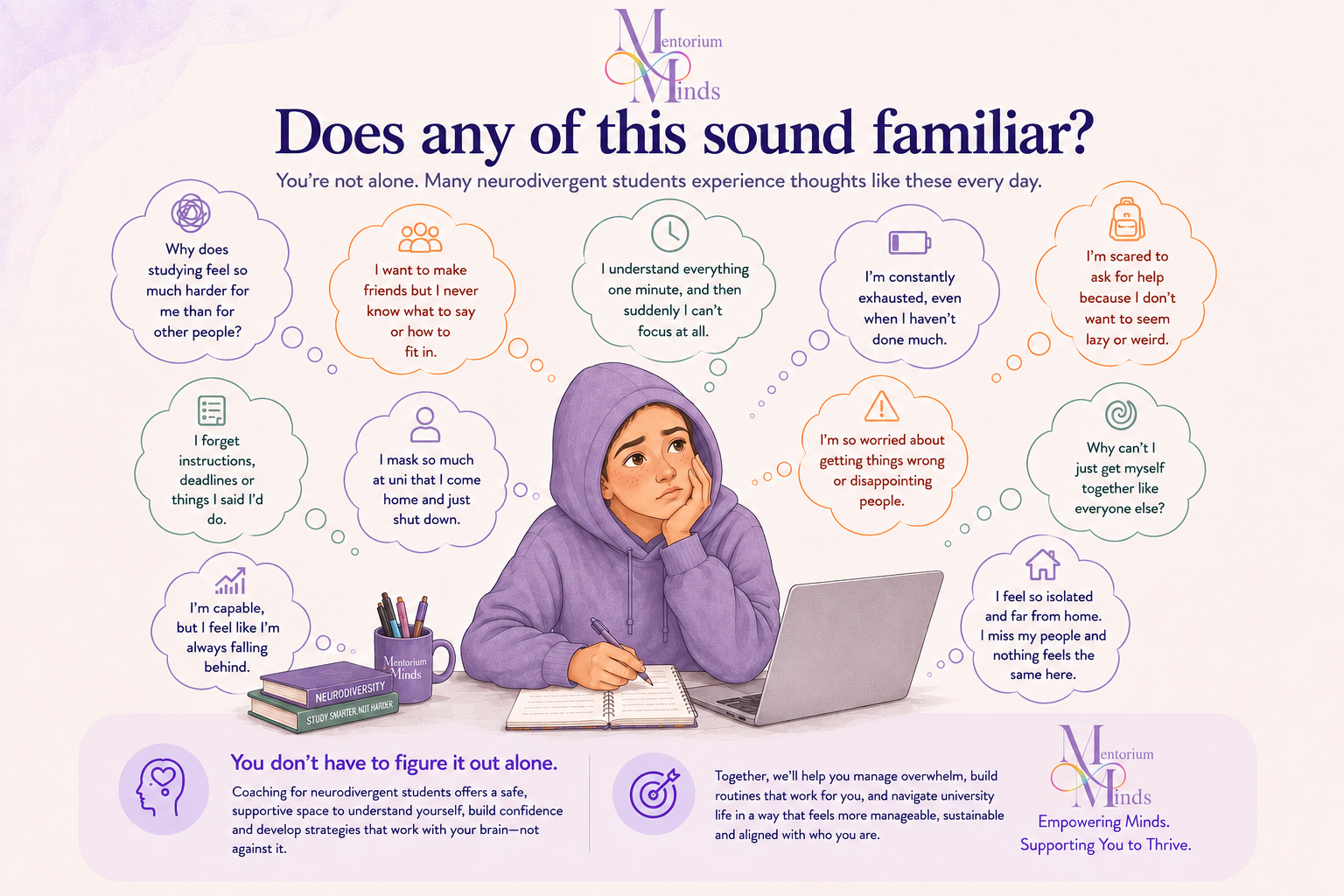
Common University Challenges
Testimonials
“The support provided has been integral to completing my degree, particularly through help with organisation and planning.
I found the organisational help using [personalised support strategies and resources] to be incredibly helpful, having all of my work and support in one place made everything a lot more streamlined and manageable.
I would highly recommend Maryam [Founder, Mentorium Minds] as she is incredibly friendly, supportive and is excellent at tailoring how support is delivered to the students specific needs.”
— Dafydd, BSc Environmental Geoscience Graduate, former DSA Student
“My mentor was very supportive and the weekly check ins did help a lot to keep me on track and break down tasks into manageable chunks.”
- Healthcare student, previously in receipt of SM-ASCThink you could benefit from Specialist Mentoring (ASC)?
I already have DSA funding
If you've been awarded Specialist Mentoring (ASC) support through DSA, you're ready to get started.
I haven’t applied for DSA yet
Think you could benefit from Specialist Mentoring (ASC)? Start your DSA application to access funded support.
I am not eligible for DSA
If you aren't eligible for DSA, are waiting for funding, or would simply like additional support, private mentoring may be the right option for you.
-
Specialist Mentoring (ASC) is a form of one-to-one support funded through Disabled Students' Allowance (DSA) for eligible university students.
Sessions are tailored to your individual needs and focus on developing practical strategies that help you manage the academic and everyday demands of university.
-
Support is personalised and may include:
Planning and organisation
Time management and executive functioning
Managing overwhelm and burnout
Communication with lecturers and peers
Breaking down assignments into manageable steps
Building confidence and self-advocacy
Creating routines that work for you
Developing strategies that support long-term independence
Every student's support looks different, and sessions are always tailored to your goals.
Our Resources page includes practical tools that can be used during mentoring, including our Weekly Planner for breaking down tasks, keeping track of deadlines and making busy weeks feel more manageable.
-
No. Although mentoring provides a supportive and non-judgemental space, it isn't therapy or counselling.
The focus is on practical, solution-focused strategies that help you overcome barriers affecting your studies and university experience.
-
Specialist Mentoring (ASC) is available to university students whose DSA Needs Assessment recommends this type of support.
If you haven't yet applied for DSA but think you may benefit from mentoring, you can start your application through Student Finance.
-
Specialist Mentoring (ASC) is fully funded through Disabled Students’ Allowance (DSA), at no cost to students.
-
I offer online mentoring to students nationwide across the UK, as well as face-to-face sessions in Cardiff, South Wales, subject to availability.
I provide in-person support at Cardiff University and Cardiff Metropolitan University, as well as the Cardiff campuses of University of Wales Trinity Saint David (UWTSD) and University of South Wales.
-
The exact frequency and duration of sessions will depend on your DSA recommendation and your individual needs.
For context, many students receive funding for weekly hour-long sessions.
-
Yes, you can request to work with a specific mentor/ provider.
If you're interested in working with Mentorium Minds, I'd be happy to discuss the next steps.
-
The first session is about getting to know you.
We'll talk about:
your course
your strengths
the challenges you're experiencing
your goals
how you'd like mentoring to support you
Together, we'll create a personalised plan for future sessions.
-
When your funded support comes to an end, you'll have the option to continue working with me through Private Mentoring or Access to Work if you'd like ongoing support.
This provides continuity, allowing you to keep working with someone who already understands your strengths, goals and preferred ways of working.
Frequently Asked Questions (FAQs)
Further Information
If you'd like to learn more about how Specialist Mentoring is funded through Disabled Students' Allowance (DSA), you can view our current Non-Medical Helper (NMH) Provider Rates for the 2026/2027 academic year here.
Face-to-face Support Availability
Current face-to-face coverage includes Cardiff University (Cathays and Heath Park), Cardiff Metropolitan University (Llandaff and Cyncoed), University of South Wales (Cardiff Campus), and University of Wales Trinity Saint David (Cardiff Campus).




Face-to-face support may also be available to students who live in Cardiff but commute to a university outside the city, or who study remotely through a distance-learning provider such as The Open University. Sessions can be arranged at a suitable location within Cardiff.
Case Study: Supporting a Healthcare Student in the Final Months of Their Degree
After almost five years of study, this student began Specialist Mentoring (ASC) with just three months left of their integrated master's degree in healthcare.
At this stage, they were managing significant academic demands while also navigating difficult personal circumstances beyond university which were affecting their capacity to manage their workload, stay engaged with their studies, and make progress towards what remained of their degree. With relatively little time left, mentoring focused on helping the student work through these barriers while continuing to move towards completion.
Structure, Flexibility and Manageable Goals
Weekly mentoring provided a sense of routine and a consistent point of support, while staying flexible enough to respond to what the student was experiencing at the time.
Realistic, achievable goals were identified collaboratively — giving direction between sessions without adding extra pressure when circumstances changed. Larger or overwhelming demands, including assessments, were broken down into smaller, manageable steps, alongside strategies for organisation, planning, prioritisation and managing deadlines.
Rather than following a fixed programme, priorities and strategies were reviewed regularly, allowing mentoring to respond to changes in the student's circumstances while continuing to work towards their academic goals.
Wider circumstances were recognised as an important part of understanding the student's experience — including how these were affecting their wellbeing, capacity and studies. Mentoring maintained an educational focus while developing strategies around the impact of these circumstances on academic engagement.
When asked what they found most valuable about the support, the student highlighted this adaptability:
"Regular check ins to adapt to the issues with health I was experiencing."
And when asked directly whether Specialist Mentoring had helped them continue engaging with their studies during periods of difficulty, their response was:
"Yes, significantly."
The Impact of Support
The student reported:
✓ More effective management of their workload
✓ Improved confidence as a student
✓ Progress towards their academic goals
✓ Support with organisation, planning & managing deadlines
✓ Understanding the support available to them
✓ Reduced overwhelm and stress
The aim was not simply to manage academic tasks within sessions, but to help the student develop approaches they could use more independently, between sessions and beyond. Reflecting on the practical impact of weekly mentoring, they explained:
"My mentor [Maryam, Mentorium Minds Founder] was very supportive and the weekly check ins did help a lot to keep me on track and break down tasks into manageable chunks."
Looking Beyond University
The value the student placed on the mentoring relationship extended beyond their degree. They said they would recommend their mentor to another student, and expressed an interest in continuing support beyond university, using Access to Work funding.
Their experience reflects a principle underpinning Specialist Mentoring at Mentorium Minds: university does not happen in isolation. Wider circumstances can influence a student's capacity to organise, initiate tasks, manage academic demands and remain engaged with their course. Specialist Mentoring provides space to recognise these interactions while maintaining an educational focus and developing practical, individualised strategies around their impact on study.
By the end of the support period, the student had successfully completed their degree. Three months represented only a small part of this student's five-year university journey — but during a particularly demanding final stage, consistent and adaptable Specialist Mentoring helped them manage academic demands, maintain engagement, and continue progressing towards completion.
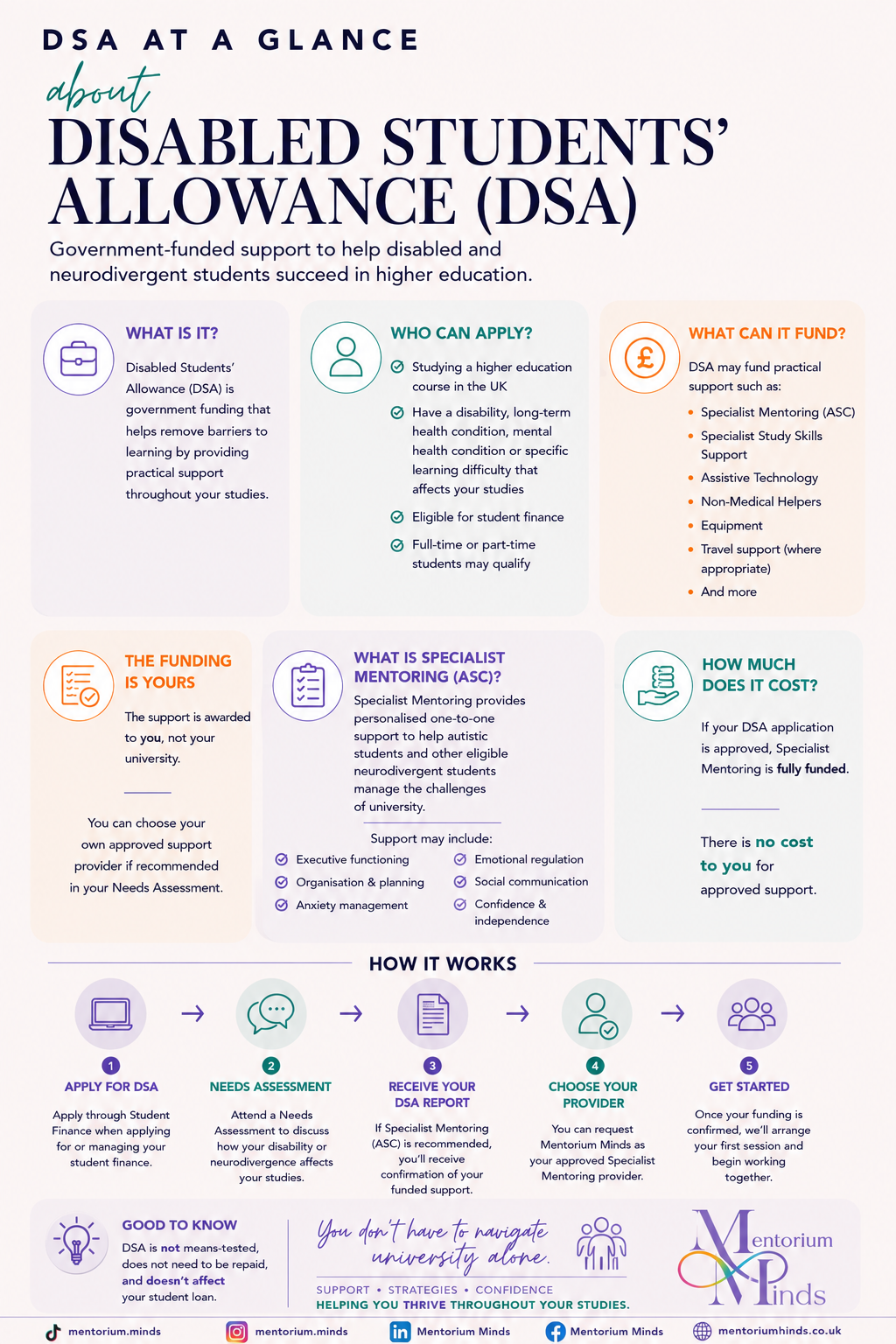
Your DSA Cheat Sheet
A handy reference guide to come back to whenever you need it.